New Literacy at the Public Library

A few weeks ago, Wired magazine published a great article by Clive Thompson on “the New Literacy, debunking that tired old argument that TV, computers & texting are destroying literacy and civilization.

Au contraire, what Andrea Lunsford found in a recent study at Stanford is that more young students are generating so much more creative content in their free time than any previous generation, and that this content is often highly nuanced — they know how to assess their audience and adapt their tone to get their point across.  And my favorite quote from the article: “The brevity of texting and status updating teaches young people to deploy haiku-like concision.”

At my public library I encourage teenagers to blog, create podcasts and produce YouTube videos.  I want them to see themselves as creators of content rather than mere content consumers.  I think this is utterly empowering for them, and it’s fantastic to see some exciting & innovative research coming out of Lunsford’s study to validate these objectives!
Kindle Demonstration & Notes

This Friday I got to demonstrate some features of my Kindle 2.0 to a group of about 20 staff at my library.  We’re getting ready to go the e-book route, which I think is very exciting.  I feel so grateful that my library is willing to embrace and explore new technologies — we circulate video game systems, laptops, flip cameras, and our reference services entail chatting, texting, blogging and technology instruction. . .

Anyway, I’m getting distracted from what I REALLY wanted to tell you about, which is libraries and e-Books.  It looks like my library is going to end up going with Sony e-Readers, because we already use the Overdrive service for audiobooks, and Overdrive just partnered up with Sony to offer content for their e-Readers earlier this summer.  This makes me sad for entirely selfish reasons, because I use a Kindle — but that’s just the way it goes in the format wars.  And it does really bug me that the Kindle is so proprietary and DRM-y — but all the better to hack, my dear!  (And lest we forget — Sony is not exactly exempt from the evils of DRM, either.  Remember that fiasco?)

Continue reading

The Authentic Librarian, Teacher, Student & Self

Well, the fall semester is finally here, along with all the attendant responsibilities:  lectures, readings, research, assignments, collaborations, conferences, my graduate assistantship, as well as continuing Teen Tech Zone and Teen Advisory Group with the fabulous teenagers at my public library.  Maybe all this will help explain the recent lapse in posts here on Librarian in a Banana Suit…

This semester I’ve noticed something new in my classes, although I don’t think it’s a new phenomenon at all — it’s just the first time I’ve happened to observe it:  my instructors are nervous!  Sweaty palms, self-deprecating jibes, fidgeting with the AV equipment, mumbling nervously to themselves, etc.  They are TERRIFIED to meet a new crop of students who will be judging them on their aptitudes as teachers for the duration of the semester.  As the instructors get to know us, they will become more comfortable and relaxed, I’m sure.  It’s funny how I’ve never really noticed those first-day jitters before.

Continue reading

Science Fiction and Fantasy: Uncovering the Modern World of Information, Society, and Technology through Metaphor and Imagination; ALA Annual Conference 2009

(presented by LITA)

Milton Wolf from the LITA Imagineering Interest Group introduced the speakers for this event, which ended up being primarily a publicity stop for Tor Books authors.  I was disappointed that we didn’t talk more about technology, metaphor and imagination — as the program guide had suggested — but what’s a girl to do?

Robert Charles Wilson began with a brief but eloquent talk about his new book, Julian Comstock: A Story of 22-nd Century America.  Set in America after apocalyptic problems such as environmental meltdown and a plague of infertility, this is a story about political reform and restoration ~ especially the restoration of a Free Public Library System.  Wilson argued that information and knowledge will always “want to be free.”  Julian Comstock sounds like an absolutely fantastic novel and I wish Wilson were more comfortable as a public speaker, because I have the feeling I could have listened to him talk about what’s on his mind forever (or at least a few hours).

Continue reading

Life After 2.0; ALA Annual Conference 2009

(presented by PLA)

Lori Bell, Director of Innovation at Alliance Library System in East Peoria, IL, came to this session to demonstrate her library’s amazing Second Life virtual library project, “Info Island Archipelago.”  Second Life libraries are great meeting places for people who want to use avatars to meet from a distance.  Virtual libraries don’t even have to look like buildings — they can look however we want them to look.  They don’t have to be constrained by walls, and the weather can be perfect every day.  And, just like the Info Island Archipelago, your reference librarian can be. . . Yoda.

Continue reading

Technology in the Developing World; ALA Annual Conference 2009

(presented by LITA)

OLPC3

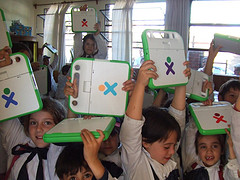
Randy Ramusack, the United Nations Technology Officer for Microsoft Corporation (Research4Life), came to this ALA session to talk about Microsoft and “Creative Capitalism.”  The undisputed star of the show, however, was Matt Keller, who is the Director of Europe, Middle East & Africa, One Laptop Per Child program.

Although you might recognize OLPC for their cute little XO laptops that began the Netbook craze, Keller stressed that OLPC is an education program instead of a technology program.  Based in the U.S., OLPC is a non-profit organization that sets up and supports laptop-distribution programs in developing countries.  The programs are  then run by independent organizations (such as NGOs) in their home countries.  Continue reading

Tennesse Schools Unblock LGBTQ Websites

In May, the American Civil Liberties Union (ACLU) of Tennessee filed suit against the Knox County and Metro Nashville school district for blocking lesbian, gay, bisexual, transgender and queer websites.  Two weeks later, on June 3rd, the school districts announced that they would stop filtering the websites of gay-friendly advocacy groups such as the Gay, Lesbian, and Straight Education Network (GLSEN) and Parents, Families, and Friends of Lesbians and Gays (PFLAG).  You can read the full article about the decision here.

A lot of schools and libraries filter their Internet to block explicit sexual or violent content.  In fact, post Children’s Online Protection Act (COPA) / and Children’s Internet Protection Act (CIPA) legislation, many public libraries are required to use Internet filtering software if they want to receive funding from the federal E-Rate program.

Continue reading

Teens Need Intellectual Freedom, Too

Earlier this month, someone from the Pelham, NY, public library tattled to the high school principal after an eleventh grader was at the library researching gun conceal & carry laws.  The student was called into the assistant principal’s office and interviewed by the police.  After talking to the student, police Detective Kevin Campion assured everyone that there was nothing to be worried about and that the student had not broken any laws.

Many public libraries make a commitment to their communities–including teens!–that they will protect everyone’s privacy.  You may have heard of a little thing we like to call Intellectual Freedom.  The U.S. Constitution guarantees us the right to access any and all information without fear of persecution (excepting obscenity, libel and fighting words), and librarians have really taken that to heart.

Continue reading

Recap: ILA Technology Petting Zoo

Yesterday was the Iowa Library Association’s Support Staff Spring Conference: Technology Petting  Zoo.  And I just have to say, I met some of the most awesome, forward-thinking, teched-out librarians in the state of Iowa, seriously.  About 40 librarians from around the state showed up, from their mid-twenties to their mid-sixties, and we had such a blast playing with Kindle, iPod Touch, Facebook, Smart Boards, digital cameras. . . &c!  After downing some yummy pecan sticky buns and cups of coffee (sorely needed after waking up at 6:30 am for the hour-long drive), we split up into 4 small groups and rotated around the room for 75 minute sessions with each of the 4 presenters.  So I guess I’ll just give you a little run-down on each presenter and what she or he brought for us to play with.

Continue reading

Public Praxis: A Vision for Critical Information Literacy in Public Libraries

Update: 10/26/2010 — An updated version of this article is now available in Public Library Quarterly: Vol. 29, Issue 2, p. 162

This paper was a labor of love; it was written for my Literacy and Learning course with James Elmborg this semester.  In trying to understand why public libraries haven’t paid as much attention to “information literacy” as school and college libraries, I ended up writing about how public libraries can devote themselves to the “continuous process of forming whole human beings—their knowledge and aptitudes, as well as the critical faculty and the ability to act” (IFLA ), and about why I think it’s important for them to do just that.  I also talk about Paolo Freire; John Dewey; Web 2.0; New Literacy Studies; and information literacy programs at public libraries in the province of Mpumalanga, South Africa.

Continue reading below to see the full text of the paper, or click here to download the pdf.

Continue reading