In Three Acts

Since I’ve been contributing to everyone else’s blogs lately, I thought you all deserved a little update, too.  Here it is, in three acts.  Happy birthday!

act i: what I’ve been reading

scene 1: Fifty Shades of Grey

This book really is as terrible as everyone says it is.  But I still loved reading it and would do it again; here’s why.  For the cynical take, you’ll have to check-in with twitter friends @knsstxs (“reading that book is my own red room of pain,”) and @theluckynun  (“I could write better one-handed reading with one hand tied behind my back & some gross dude spanking me.”)  I also enjoyed Chip’s ostentatiously lazy review.

scene 2: Love is a Mix Tape

Gawd, what a great piece of pop culture writing.  I heart Rob Sheffield, and this book made me cry like a baby, even though (or perhaps because) it was about Duran Duran and Missy Elliott.  I’m going to cheat by linking to my brand new review for Lawrence Public Library — this review isn’t officially published until tomorrow.  Doesn’t it feel exclusive?

scene 3: 2666

Roberto Bolaño is totally freaking me out, in that way that only the best writers know how.  I loved Savage Detectives, but 200 pages in and I’m already calling it: 2666 is Bolaño’s masterpiece.  I’m crawling along, reading just a few pages at a time, because it’s too much to take in.  This business with Amalfitano and the geometry textbook is KILLING me.

Continue reading

Marie Antoinette: Royally Frocked

(This post originally appeared in the Lawrence Public Library Spotlight.)

From the masculine equestrian outfits that made her Louis XV’s favorite, to the regal counterrevolutionary gowns in green and violet that exposed her as an enemy of the state, Marie Antoinette’s fashion statements were always unfailingly both fabulous and controversial. In Queen of Fashion: What Marie Antoinette Wore to the Revolution, Caroline Weber paints a comprehensive portrait of the fashion icon, from Dauphine until death. Weber is not only a brainy Barnard scholar, but also a fashion connoisseur herself, and her fastidiously researched political fashion memoir satisfied both my inner Vogue subscriber and my inner history nerd.

Anyone who’s watched Sofia Coppola’s film Marie Antoinette as many times as I have can easily rattle off the basics of her biography: born an Austrian, Marie Antoinette disavowed her native country in a political alliance with France to become its eventual Queen. A newcomer to the highly ritualized and chic court at Versailles, she navigated her tepid political reception as a suspect foreigner in the best way she knew how — in impeccable style. And although it all started out as fun and games, eventually it cost the Autrichienne her head on the guillotine.  From her powdered, sky-high hairdos to her divine selection of costly satin footwear, Marie Antoinette won over her adoring public at first, but quickly became a lightning rod for criticism of the French monarchy’s decadence during a national economic recession (… sound familiar?). Continue reading

Reading Smutty Books, In Honor of Banned Books Week

“How wrong is it for a woman to expect the man to build the world she wants, rather than to create it herself?” – Anaïs Nin
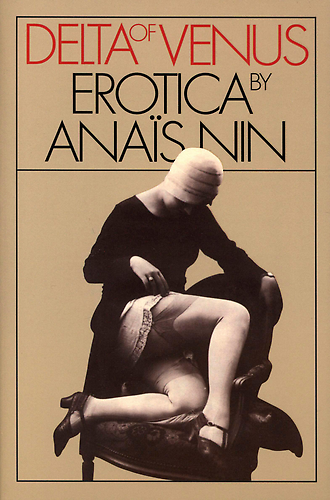
Banned Books Week starts this Saturday, on 9/24! Here’s the book I picked to write about for my library’s banned books feature. Although on the surface they might just look like naughty little stories, Anaïs Nin’s Delta of Venus and Little Birds represent a breakthrough for women’s lib and a reclamation of female sexual identity. While still often considered a serious taboo in American culture, Eros — sensuality, erotic love — is an integral facet of the human experience, and I believe that we risk losing a core piece of ourselves when we begin challenging and suppressing these voices.

Nin, a French-Cuban author who lived in Paris during most of the 1940s, is hailed by critics as one of the first women to explore fully the realm of erotic writing; before her, erotica written by women was rare, with a few notable exceptions. The story goes that an anonymous patron paid Nin and her friend Henry Miller $1 per page to write erotic vignettes, and that the pair continued writing the stories as a little joke. Whatever the true genesis of Delta of Venus and Little Birds, the income sustained one of the most mysterious, sensual, and feminine voices of the 20th century.

What I admire most about Anaïs Nin as a writer, and these two volumes in particular, is that she had the courage to challenge a masculine construction of the female experience and instead offer something wholly female. She believed in sharing her own unique voice, and then used that authorial voice to create a world all her own. Fearlessly, Nin plunged the depths of an American taboo, staying true to her view that “The role of a writer is not to say what we can all say, but what we are unable to say.”

What about you — do you have a favorite banned book?  ALA has a great list of banned book resources ready to go for Banned Books Week.
Poetrying Your Way Through the Public Library

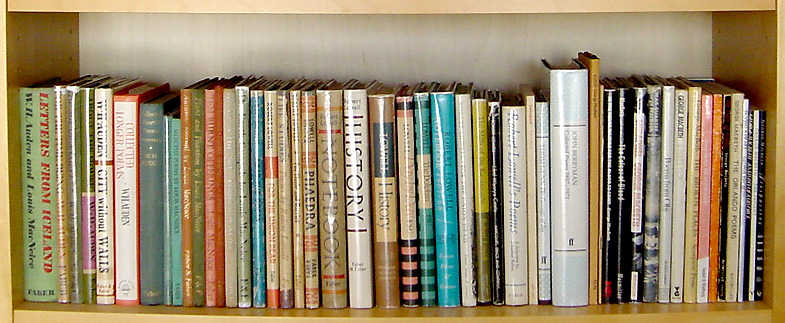
Many thanks to poet and birth doula V. Wetlaufer for penning this guest post on poetry & public libraries!  V. is a Lambda Literary Fellow, the author of two chapbooks — Scent of Shatter and Bad Wife Spankings — and her poetry has appeared in Drunken Boat, Word Riot and Bloom.  She also blogs regularly at The V-Spot.

.

Poetry Shelf

I owe my start in poetry writing to my undergraduate college’s library. Crossett Library is small, but what they lack in numbers they make up for in the quality of their collection. I was in my regular library carrel, where I went to complete all my schoolwork senior year, writing a paper for a literature class, when I decided I needed a break. Off to the shelves I went to find a collection of poetry. I randomly selected a collection of Adrienne Rich’s poetry and opened the volume at random. So moved by her work was I that, having never written a poem before, I scribbled my very first poem inspired by a book plucked at random from the shelves.

I’m fortunate enough these days to live in a city with a fantastic public library, Salt Lake City, as well as a truly incredible university library I rely on for my PhD program. However, I am always saddened when I turn to a library to feed my poetry needs and the poetry collection is sadly lacking. I am especially sad when there is a dearth of contemporary poetry. I am a huge fan of poetry from Chaucer to Wordsworth, Whitman and Eliot and everyone in between, but I believe that the best way for the majority of people to encounter poetry for the first time is through contemporary work. Continue reading

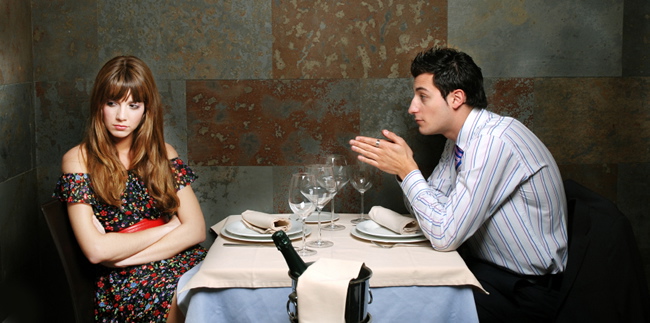
Tolstoy’s Like a Bad Date Who Doesn’t Know When to Stop Talking About Himself

Bad Date

Almost exactly two years ago, I gave my mom and four siblings each a copy of War and Peace for Christmas. I’ve kind of been talking about it a lot lately.

The premise was to do a long-distance book group, at a nice and easy clip of 1200 pages in one year. That’s only 100 pages a month!  But I’ve since concluded that book group etiquette asks a commitment of at most 300 pages from each person at a time, preferably less. Although most of my family said they really wanted to read it, the execution itself was a little more… challenging. A year is a long time. 1200 pages is a lot of pages.

2009 came and went, but still I’d read only half. Then, in November of last year, with 800 pages under my belt, I decided enough was enough. And I finally finished, on Dec. 27, squeaking in just under the two-year mark.

And? It’s brilliant! Obsessed with the microcosm, Tolstoy deconstructs major historic events through the eyes of half a dozen characters whom we watch grow-up from childhood. He’s a starry-eyed romantic, yet he’s also one of the most weirdly hilarious guys I’ve ever read. Drunken frat boys wrestling bears, crabby old men with sneezing problems, Tsars throwing biscuits from balconies, anagrams of Satan’s name… When Tolstoy wants it to, the story really soars, and he’s the best drama queen that ever was a drama queen. Continue reading

Cookbooks I Have Loved

Better Homes and Gardens New CookbookWhen I was a little girl, we cooked from two places: the Better Homes & Gardens New Cookbook, and my mom’s recipe box.  With five little kids in the family, we weren’t the most sophisticated diners, although we did eat together at the dinner table every single night.  We’d help Mom peruse The Cookbook, begging her to try new recipes like One-Pot Spaghetti, Cheesy Potato Bread, and Cowboy Caviar.  But usually she’d cook something from her recipe box: German Meatballs, Creamy Broccoli Chicken, Homemade Macaroni and Cheese.  My Norwegian grandmother lived in our basement, and occasionally she would whip up an exotic feast to nourish the whole family: Lefse, Potato Balls, Flötegröt.  She died nearly 20 years ago, but I still cherish her handwritten recipe cards, tucked away in my own tiny collection of recipes.  And on Saturday mornings, it was my dad’s turn to cook.  He made truly bizarre Wholewheat Pineapple Pancakes, but I loved them, although my favorite Saturday morning breakfasts were (and still are) Popovers, and Poached Eggs.

As I’ve matured, so has my palate, and throughout this past decade I’ve accrued a small collection of cookbooks to buttress my tastes.  When my oldest brother Dan returned home for Thanksgiving after he’d grown up and moved away to Vermont, he brought home The Joy of Cooking and set out to brine a turkey.  I made a Cranberry Conserve: “This is a luxurious form of cranberry sauce, with uncommon beauty, texture, and flavor,” writes the authoress, Irma Rombauer.  It was a revelation.

Cooking adventures ensued!  I lived in Rome one Spring, and became obsessed with The Silver Spoon and Marcella Hazan’s The Essentials of Classic Italian Cooking.  That was the Spring I made hand-made ravioli with friends for the first time, and my roommate Alexis showed me how to sear and then slowcook a rump roast with nothing but salt & pepper, oil, and red wine. Continue reading

Being a Librarian Who Hasn’t Read Harry Potter is Like Being an English Professor Who Hasn’t Read Hamlet

Harry Potter Costumes

I was working as a Department Manger at a Barnes and Noble store in Burlington, Vermont, when Harry Potter and the Half-Blood Prince came out. We held a midnight release party, and I remember children trying to stab each other with wands for several hours before they were finally allowed to buy their books and go home. Many of the parents came in full costume, and it was obvious that they were more obsessed with Harry Potter than their kids. The next morning, sales associates arrived to work crying, having stayed up since 2 a.m. reading only to learn of their beloved Dumbledore’s tragic demise.

Five years later, as a public librarian, the fact that I still haven’t read Harry Potter feels like a dirty little secret.  I can’t help but recall that urban legend of academia, as told by Pierre Bayard in How to Talk About Books You Haven’t Read, in which an English professor reveals during a faculty cocktail party that he’s never read Hamlet, and is instantly fired.

Continue reading

Reading Tolstoy, Alone.

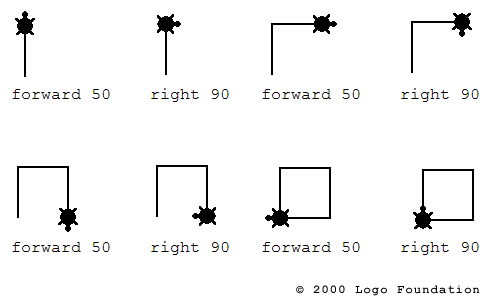
My husband and I could not be more different from each other.  In a few ways, at least.  Case in point: I spent my childhood hiding under the covers with a flashlight and a copy of The Snarkout Boys and the Avocado of Death, while he spent his summers at Computer Camp programming the little Logo turtle to make triangles and squares.  I’m an avid reader and librarian; he’s a complete computer whiz who could program his way right into whatever industry he chooses.

When Aaron was just a little boy, his dad brought home the Commodore 64 that would seal his fate as a hot computer nerd.  As a mere seventh grader, he self-taught his way through a book of how to code in C.  While I was auditioning for high school plays, my husband was teaching himself database architecture via a little homegrown website called “Synthetic” that he’d built in his basement.  When he first wooed me, he wrote me a little program called “arrow_kill” to destroy all those nasty little carrots — “>>>>” — that show up in email trails.  I hate those things!  It totally worked.  Now Aaron predicts chemical / protein interactions using computer simulations.  This is cutting-edge, sought-after, super sexy stuff in the multi-billion dollar pharmaceutical industry.

Continue reading

Librarian’s Advisory

If you’ve been following this blog for any length of time, you may recall that I have sort of a love-hate relationship with what we here in the library like to call “Reader’s Advisory.” Don’t panic — I’m not going to rehash that whole thing!

Yet I had the coolest Reader’s Advisory experience here at the public library the other day, and now I’m dying to know if other librarians have experienced this, too. I’m going to call it “Librarian’s Advisory.” Here’s what happened: Continue reading