“How wrong is it for a woman to expect the man to build the world she wants, rather than to create it herself?” – Anaïs Nin
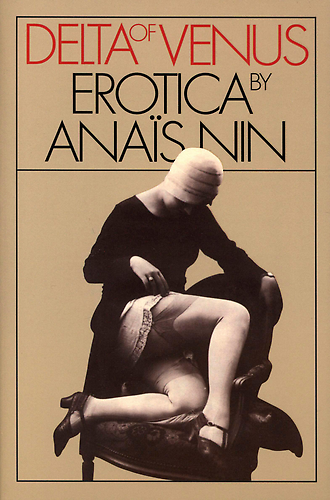 Banned Books Week starts this Saturday, on 9/24! Here’s the book I picked to write about for my library’s banned books feature. Although on the surface they might just look like naughty little stories, Anaïs Nin’s Delta of Venus and Little Birds represent a breakthrough for women’s lib and a reclamation of female sexual identity. While still often considered a serious taboo in American culture, Eros — sensuality, erotic love — is an integral facet of the human experience, and I believe that we risk losing a core piece of ourselves when we begin challenging and suppressing these voices.
Nin, a French-Cuban author who lived in Paris during most of the 1940s, is hailed by critics as one of the first women to explore fully the realm of erotic writing; before her, erotica written by women was rare, with a few notable exceptions. The story goes that an anonymous patron paid Nin and her friend Henry Miller $1 per page to write erotic vignettes, and that the pair continued writing the stories as a little joke. Whatever the true genesis of Delta of Venus and Little Birds, the income sustained one of the most mysterious, sensual, and feminine voices of the 20th century.
What I admire most about Anaïs Nin as a writer, and these two volumes in particular, is that she had the courage to challenge a masculine construction of the female experience and instead offer something wholly female. She believed in sharing her own unique voice, and then used that authorial voice to create a world all her own. Fearlessly, Nin plunged the depths of an American taboo, staying true to her view that “The role of a writer is not to say what we can all say, but what we are unable to say.”
What about you — do you have a favorite banned book? ALA has a great list of banned book resources ready to go for Banned Books Week.