The Other, Sadder, Face of the Library

So I know I like to have a little bit of fun here on Librarian in a Banana Suit.  In the last few months alone I’ve written about helping patrons find sex books, finding out if betrothed couples are second cousins or not, and scouring the catalog for novels about psychoactive soy sauce.

But there are many other facets to this job, too — many of them quite sobering.  Working closely with the public as trusted liaisons between them and their deepest information desires, we’re often asked very sensitive questions: we receive reference inquiries about domestic violence, unemployment, learning disabilities, and sexuality, and I’m astounded and humbled that patrons think of the public library as a place to find answers to these kinds of questions.  We can often refer them to social service agencies around the community, which I like to think means we’ve connected them with information that will ultimately really help them.

That’s not what happened a few weeks ago, though.  I was asked a different sort of question, one that was incredibly sensitive but indeed required the skills of a reference librarian.  Towards the end of the evening, a patron came in to look for the obituary of her friend.  She had been trying to get a hold of him on the phone for months when a mutual acquaintance told her that he’d committed suicide earlier this fall.  “I just want black and white confirmation, in print, that it’s true,” she told me.
Continue reading

Christmas With Bibliophiles

Hello again!  Aaron and I just returned from an energizing holiday weekend in Iowa.  I’d like to thank the Iowa winter for its complimentary drill in snow-storm driving — Kansas has been making me soft.

As we gradually get back into the swing of things, I just want to tell you all shortly & sweetly about our Christmas spent with bibliophiles.  Some families give each other clothing, electronics, toys, and gadgets, but in our family we see a ton of books come out from underneath the tree.  Here’s a quick recap of what we all gave & got:

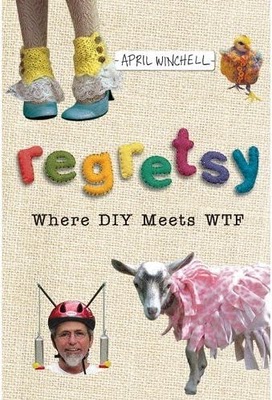
Regretsy Regretsy: Where DIY Meets WTF 

I hadn’t heard of the Regretsy blog before, but they had me immediately at the Fish-in-a-Squirrel-Suit Taxidermy and the Phallic Chapstick Cozy.  The sublimely awful DIY projects chronicled here have all been actually listed — and yes, even bought — on Etsy, some for several hundred dollars.  It kind of defies explanation; you just have to see it for yourself.

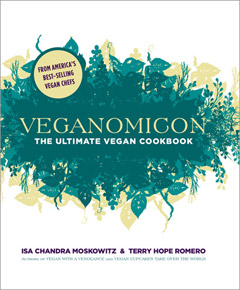
The Veganomicon The Veganomicon 

My step-sister and I got to geek out about meatless eating over the holidays.  Although we never got around to making that tofurkey, we did commiserate about all the mashed potatoes we ended up eating for dinner.  She squealed when she opened up this book from her sister, and I’m dying to check out what’s in-between the covers!

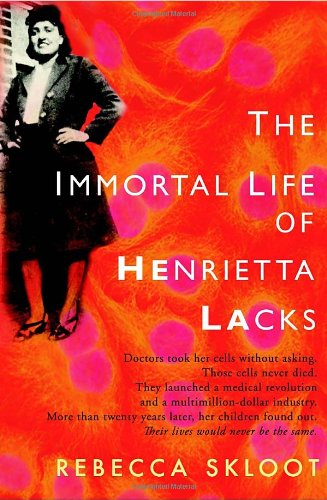
The Immortal Life of Henrietta Lacks The Immortal Life of Henrietta Lacks 

I first heard about this fascinating book on an episode of one of my favorite public radio shows, RadioLab.  As the story of the woman who posthumously — and unknowingly — contributed cancerous cells for one of the very first stem cell experiments, I think it suits my physician-bibliophile brother very well.

Continue reading

From Intergalactic Time Travel to Psychoactive Soy Sauce: Crowdsourcing at the Public Library

Just a week or so ago, the fabulous Julia Skinner authored a guest post here about crowdsourcing in 20th century libraries.  Today I’m following up with a little story about 21st century crowdsourcing!

Crowdsourcing

I think librarians everywhere can relate to this classic scenario:  a woman walked into our library last weekend wanting to find a book she’d read, but she couldn’t remember anything about it.  She began by describing a paranormal time traveling plot to my colleague:  “It’s about this guy who time travels between planets.  He works at a video store, and his best friend’s disabled sister is a major player in the plot.  Oh, and there are a bunch of people who aren’t quite what they seem.”

Soon I was recruited to help out, but by this time the patron’s story had morphed and had nothing to do with intergalactic time travel:  “So this guy wanders into an old building with portals to alternate realities, and then he turns into a demon.  I think his name is Evan, and the title is something catchy like Don’t Read This Book.”  She considered for a moment and then added, “but I just read another book with an Evan, so that might just be my default when I’m trying to think of a character?”

Continue reading

Crowdsourcing and Collaboration: 20th Century Style!

Thanks so much to my friend and colleague, Julia Skinner, for writing this guest post.  She’s a historian,  book-arts whiz, and she blogs regularly at Julia’s Library Research Blog and Modernizing Markham.  She’s also currently on the prowl for someone to publish her book on World War I-Era Libraries.


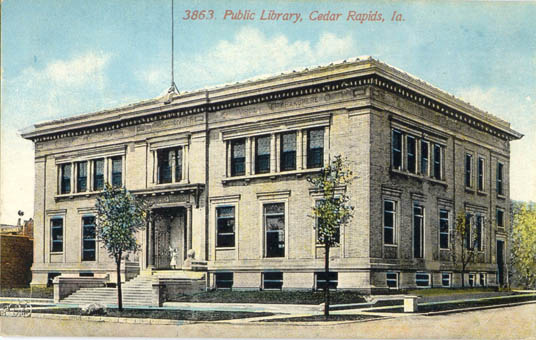
Cedar Rapids Carnegie Library
I’ve been feeling so inspired lately by all the exciting work people around the country are doing with #HackLibSchool (a collaborative effort by students to discuss library school and to share experiences and tips), and I can’t help seeing connections in other areas of my life! I just finished up a major research project on World War I-era Iowa libraries, in which I looked at 6 Eastern Iowa libraries and talked about their administrative records in the context of the statewide and national climate. I was amazed that even in an era before the Internet (or private telephone lines) librarians were collaborating and sharing resources, and using each other as inspiration!

Librarians from several of the libraries would visit each other to talk about what was going on in their libraries and share ideas — in Cedar Rapids especially, the librarian mentioned meeting with others in Eastern Iowa. She even compiled statistics about all the libraries so she could compare how they were doing! Like today, librarians also attended conferences, and they also wrote reports about what was discussed and what they learned. What’s really cool is the overlap between what they discussed then and what it discussed now — there was a lot of talk about how to improve services to patrons!

Continue reading

Cookbooks I Have Loved

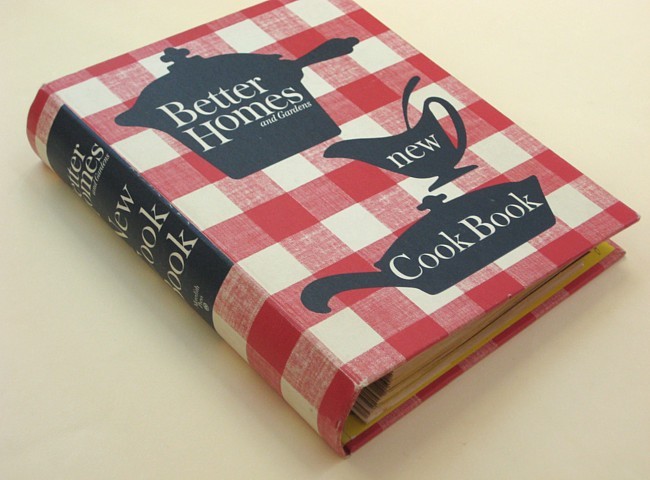
Better Homes and Gardens New CookbookWhen I was a little girl, we cooked from two places: the Better Homes & Gardens New Cookbook, and my mom’s recipe box.  With five little kids in the family, we weren’t the most sophisticated diners, although we did eat together at the dinner table every single night.  We’d help Mom peruse The Cookbook, begging her to try new recipes like One-Pot Spaghetti, Cheesy Potato Bread, and Cowboy Caviar.  But usually she’d cook something from her recipe box: German Meatballs, Creamy Broccoli Chicken, Homemade Macaroni and Cheese.  My Norwegian grandmother lived in our basement, and occasionally she would whip up an exotic feast to nourish the whole family: Lefse, Potato Balls, Flötegröt.  She died nearly 20 years ago, but I still cherish her handwritten recipe cards, tucked away in my own tiny collection of recipes.  And on Saturday mornings, it was my dad’s turn to cook.  He made truly bizarre Wholewheat Pineapple Pancakes, but I loved them, although my favorite Saturday morning breakfasts were (and still are) Popovers, and Poached Eggs.

As I’ve matured, so has my palate, and throughout this past decade I’ve accrued a small collection of cookbooks to buttress my tastes.  When my oldest brother Dan returned home for Thanksgiving after he’d grown up and moved away to Vermont, he brought home The Joy of Cooking and set out to brine a turkey.  I made a Cranberry Conserve: “This is a luxurious form of cranberry sauce, with uncommon beauty, texture, and flavor,” writes the authoress, Irma Rombauer.  It was a revelation.

Cooking adventures ensued!  I lived in Rome one Spring, and became obsessed with The Silver Spoon and Marcella Hazan’s The Essentials of Classic Italian Cooking.  That was the Spring I made hand-made ravioli with friends for the first time, and my roommate Alexis showed me how to sear and then slowcook a rump roast with nothing but salt & pepper, oil, and red wine. Continue reading

Pythons & Snow Bunnies

Around this time last winter, I was learning how to write code in the computer language, Python.  I thought that knowing how to code would make me a better librarian, and so I signed up for a grad class at the U of I.  For the record, I hadn’t cried because of a class since the fifth grade, when Mrs. Recinos gave me a “late” because I forgot to ask my parents to sign my assignment notebook.  But Readers, Python made me cry.

Eventually, though, I ended up with this cute little piece of code that can make collages out of pictures that you like:

Snow Bunny Collage

My professor was really amazing, and in the end I actually did OK in the class.  Having a supportive, code-savvy fiance with a knack for soothing hysterical people also helped.  But librarians — even though I know I couldn’t crank out a Python program on the spot today if my life depended on it, I do know that I could sit down with a text book for a few hours and figure it out, and that I am also now equipped to have intelligent conversations with library IT staff who write code for the library.  It’s nice to know that I can participate in building our library’s tools.

Continue reading

Helping Patrons Find Out If They’re Second Cousins, Before They Get Hitched

There is never a dull moment at the public library.  I swear I’m not making any of this up.  Today’s installment of Librarian in a Banana Suit is brought to you by the patron who walked into the library last weekend wanting to know, “Would my brother’s son be my cousin’s daughter’s third cousin, or second?”  She looked imploringly at me.  I looked back.  “We’re having a family dispute about a couple who wants to get married,” she continued.

It took me several seconds to draw the family tree in my head.  Actually we had to draw it on paper.  “I’m not sure…” I hesitated.

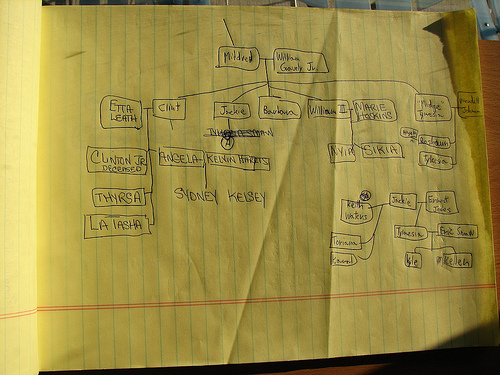
Family Tree(Disclaimer: this is not really her family tree)

Turning to the copy of Webster’s 1993 Unabridged Dictionary that sits behind the reference desk, where passers-by often stand to spy on us, we flipped to the “C”s and read that “cousin” (def. 1c) is:

a relative descended from one’s grandparent or from a more remote ancestor by two or more steps and in a different line; a distinction often being made between (1) those descended an equal number of steps and (2) those descended an unequal number of steps from a common ancestor <the children of first ~s are second ~s to each other, the children of second ~s are third ~s, etc.><the child of one’s first ~ is one’s first ~ once removed, the latter’s child is one’s first ~ twice removed, etc., though these are often called also second and third ~s respectively.>

“So that makes them third cousins!” she said, relieved.  “Well, I don’t know if that’s really what they are saying,” I hesitated again, squinting long and hard at Webster’s definition.

Continue reading

How I Learned to Stop Worrying and Love My Kindle

Kindle

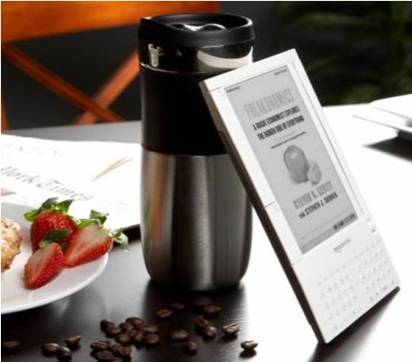
When I first bought my Kindle about 18 months ago, it was kind of a pain in the neck to use.  Amazon offered a pretty limited selection of titles for purchase that didn’t quite suit my nerdy tastes, and I couldn’t buy titles from anyone else because they wouldn’t be compatible with my Kindle.  Which was actually OK by me, because they didn’t have anything I wanted to read either.

Eventually I ended up settling for a copy of War & Peace, translated by Pevear and Volokhonsky, for three reasons: a) it was available, b) I actually wanted to read it, and c) it seemed like a pretty awesome alternative to carrying around 4 pounds of book (no joke!).  I also experimented with converting several of Project Gutenberg‘s public domain .epub titles to Amazon’s proprietary .azw filetype using some free software that I downloaded from the Internet, but the outcome was fairly hideous.  So really I had spent $375 for War & Peace.

But soon things started to get interesting.  Continue reading