Reviving Local Stories

William Stafford

Last night at my library I attended a great book discussion about Kansas Poems by William Stafford, edited by Denise Low.  Denise was Poet Laureate of Kansas from 2007-09, and she was our discussion leader last night!

Denise talked to us about William Stafford, a Quaker poet from Hutchinson, KS, who published his first collection of poems when he was almost fifty, in 1962.  That collection, Traveling Through the Dark, went on to win the National Book Award, and he was named U.S. Poet Laureate just a few years later.  His Kansas poems are written in plain language and reflect on death, loss, and rural poverty, but with a deep sense of acceptance and even twinkle-in-your-eye humor.  He was also a noted pacifist; in 2007, NPR’s All Things Considered ran a National Poetry Month feature on him called “A Pacifist’s Plainspoken Poetry.”

And yet!  Most of us in the audience had never even heard of Stafford prior to the book group.  But how could that be ~ a U.S. Poet Laureate and National Book Award winner, from our very own state?  And a KU grad, no less?? Continue reading

1973 Archives: “The Frightening Computer Trend”

Dave Unplugs HAL

Yesterday as I was scavenging historical tidbits to share via my library’s #todayinhistory Twitter feed, I came across this treasure from the August 23, 1973 edition of the Lawrence Journal-World.  I’m fascinated that this satirical piece was published long before the Internet (and especially social networks) were widespread.  Viva technophobia!

To help put this in context: just five years earlier, in 1968, Stanley Kubrick had debuted “2001: A Space Odyssey” in which the computer HAL takes on an eerily human personality.  In 1970, both the VCR and dot matrix printer were introduced, bringing more tangible, enduring qualities to personal technology.  Then, in 1971, IBM introduced the first speech-recognition software (with a vocabulary of 5000 words), and the first synthesized computer voice was also demoed.  And finally, in 1972, the floodgates burst when Atari released Pong.

Yet none of this explains the article’s bizarre fixation with marital infidelity.  Ladies and gentlemen, I present:

EVERYTHING YOU WANT TO KNOW?: THE FRIGHTENING COMPUTER TREND
by Art Buchwald

WASHINGTON – Somewhere in this great land of ours there is a computer stashed full of information on you.  Whenever you want a bank loan, a credit card or a job, this computer will, in a matter of seconds, give some total stranger almost every detail of your life. Continue reading

Curating Local Twitter Lists for Your Library

List Me, BabyMy public library’s Twitter account has over 1800 followers.  1800!  This fall, a handful of us sat down to brainstorm how to get the most out of our amazing following.

In the end, we came up with three big goals.  First was to pare down the number of Tweeters we were following back, in order to focus on core users and really zero in on newsworthy happenings in our community.  Second, we came up with some key themes or “series” of tweets that we thought would appeal to our network, such as a “new to the collection” series and a “#todayinhistory” series.  And third, we set out to curate public Twitter lists that anyone in our community could subscribe to.

Ever since we began curating these lists, I get more and more excited about their potential every day.  I love that they’re so community oriented, which I believe really builds goodwill and adds an invaluable service that not many other local organizations are situated to offer.  We’re aggregating lists of individuals who have put themselves and their work out there via Twitter, thus leveraging our position in the community to help them be discovered by others who might have an interest in their work.  Some of our local lists include Lawrence Arts, Lawrence Techies, Lawrence Businesses, Lawrence Events, Lawrence Athletics, and Lawrence Bloggers.

My favorite of all these lists is Lawrence Bloggers!  Where else can you go to find a list of local bloggers??  To curate this list, we combed through all of our local followers and identified those who listed a URL in their bio (seriously, we went through 1800).  Continue reading

Eating Animals, With a Side of Transliteracy

Eating AnimalsI know many of you have been gripping the edges of your seats in suspense, white-knuckled, wondering what has become of my quest to avoid meat!  Well, I’ve taken your suggestions and browsed lots of excellent vegetarian cookbooks:  World Vegetarian by Madhur Jaffrey, Vegetarian Cooking for Everyone by Deborah Madison, How to Cook Everything Vegetarian by Mark Bittman.  I’ve also gone against your explicit advice not to read Eating Animals by Jonathan Safran Foer.

I wasn’t sure what to expect when I picked up Eating Animals.  I’d really enjoyed Everything is Illuminated after hearing Foer read from it at a tiny bookstore in St. Paul in 2003.  I associate his writing style with lush, almost giddy romanticism, and thought, “well, that plus vegetarianism, sounds warm and fuzzy.”  Readers: Eating Animals is not warm and fuzzy.

What it is is two things mostly: a philosophical exercise, and an exposé on factory farming.  I really loved it, and recommend it to anyone who’s morbidly curious about the gruesome underbelly of industrial-scale farming.  Foer really crystallized my desire to stop eating meat, and freaked me out about eggs and dairy while he was at it! But I’m not here to proselytize, so I just want to briefly critique two aspects of the book as a whole — one thing that I didn’t like very much, and another that I absolutely loved. Continue reading

Everyone Let’s Get Social

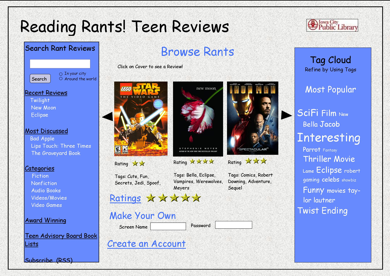
Having just attended a workshop where we talked about social bookmarking and tagging, I thought this would be an opportune time to tell you all about a fun project I worked on early last winter!  Two fellow students and I had been tasked with proposing a “digital information resource” — yep, pretty broad!!!  But our group had a strong interest in teen librarianship, and I was riding high on Andrea Lunsford’s Stanford Study of Writing, New Literacy, Content Creation, blah blah blah, and so we easily decided to propose an interactive, social catalog for teens.

Reading Rants Home

If you don’t know much about social cataloging, don’t worry — it’s a phenomenon that’s been gaining momentum over the past few years, and you can read all about the theory and the nuts & bolts behind it in our paper if you’re interested.  Continue reading

Poetrying Your Way Through the Public Library

Many thanks to poet and birth doula V. Wetlaufer for penning this guest post on poetry & public libraries!  V. is a Lambda Literary Fellow, the author of two chapbooks — Scent of Shatter and Bad Wife Spankings — and her poetry has appeared in Drunken Boat, Word Riot and Bloom.  She also blogs regularly at The V-Spot.

.

Poetry Shelf

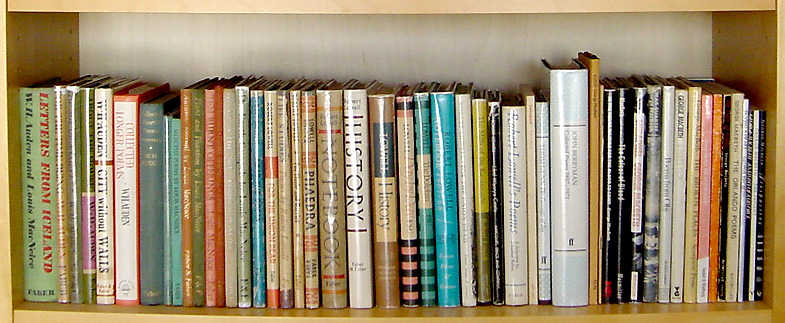
I owe my start in poetry writing to my undergraduate college’s library. Crossett Library is small, but what they lack in numbers they make up for in the quality of their collection. I was in my regular library carrel, where I went to complete all my schoolwork senior year, writing a paper for a literature class, when I decided I needed a break. Off to the shelves I went to find a collection of poetry. I randomly selected a collection of Adrienne Rich’s poetry and opened the volume at random. So moved by her work was I that, having never written a poem before, I scribbled my very first poem inspired by a book plucked at random from the shelves.

I’m fortunate enough these days to live in a city with a fantastic public library, Salt Lake City, as well as a truly incredible university library I rely on for my PhD program. However, I am always saddened when I turn to a library to feed my poetry needs and the poetry collection is sadly lacking. I am especially sad when there is a dearth of contemporary poetry. I am a huge fan of poetry from Chaucer to Wordsworth, Whitman and Eliot and everyone in between, but I believe that the best way for the majority of people to encounter poetry for the first time is through contemporary work. Continue reading

Reference Reciprocity

People are pretty weird!  In public service — or in customer service of any sort — it’s easy to get swept up in our clientele’s bizarre quirks.  And really, it wouldn’t be any fun without them.  But on the other hand, nearly all of our library patrons — even the exceptionally bizarre — are very decent people.  That’s what I love about my career in public service.  So, in honor of the decency of library patrons everywhere, I’ve got a quick story for you tonight.

Car Repair DiagramIt’s usually pretty slow on Friday nights, but that’s also when I’m asked some of the most unusual reference questions.  Tonight a patron came in to ask me how he could log-in to our website to see our Chilton’s auto repair manuals from home.  First he told me he was a mechanic, then he told me he didn’t know how to read.  I think he was expecting me — the librarian — to laugh or something, but instead I told him he could come around to my side of the desk and I’d show him where to go on the site.  He admitted then that he could read a little, but very slowly, and then he winked and told me he was a really good mechanic.  He loves the Chilton’s manuals because they have detailed visual diagrams, which are exactly the kind of information he needs to accomplish his work.  I showed him how he could get to the diagrams from home on our website, and he was so ecstatic that, at the end of the whole thing, he wrote down the name and number of his business and told me to call for free diagnostic services whenever I want.

I’m a little unsure about the policies and ethics surrounding this exchange; as a civil servant, I’m not sure that it would be right for me to accept a gift from a patron in exchange for my work — what do you guys think?  But what I loved about this exchange was that a) the patron’s information need was satisfied at the library, even though he’s not a big reader, b) we had a reciprocal exchange, viewing each other as peers who could contribute equally to the dialogue, and c) he was just really super nice.

Have a fantastic weekend, everyone, and I’ll see you back at the library soon!

New Year’s Resolution: Read More Pulp

Pulp

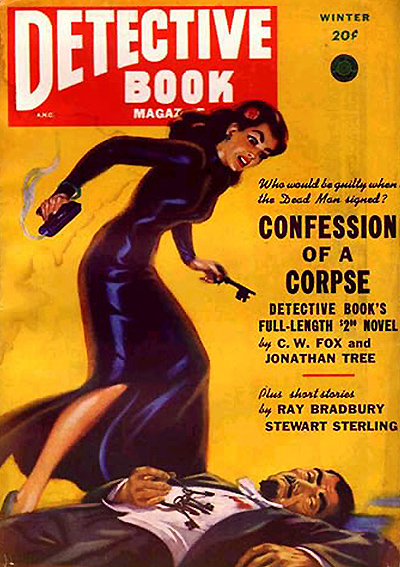
Well, somehow it’s become the “book” channel over here lately!  Hi guys, don’t mind me, just the book lady…  But I wanted to chime in briefly tonight to tell you about a New Year’s Resolution I’ve made: I’m going to read more pulp.

Being a librarian, I often get asked about my reading preferences.  As I’ve talked about here, and also here, this often makes for an awkward scenario.  I was that girl who wanted to check off every single title of the Modern Library’s list of the Best 100 Novels when she was sixteen years old.  I have an undergraduate degree in English Literature.  I love Joyce, Woolf, and Faulkner.  Believe it or not, this is kind of embarrassing when you work in a public library.

All this being said, I pride myself on having non-elitist tastes when it comes to lots of media!  Since my awkward teenage years, I’ve gotten over most of my hang-ups with pop music, blockbusters, and reality TV; these days I prefer Jaws to Citizen Kane, Project Runway to The West Wing, and Wu-Tang to Puccini.  What’s become most important to me is really, thoroughly enjoying the story — experiencing it without bias, and deciding from there whether I like it or not.  Plain and simple.  Academia has too much cultural baggage to decide these things on its own.

So why can’t I do that with books, too?

To be fair, I have branched out a little in my reading tastes.  In the last couple years I’ve started dabbling in young adult fiction, graphic novels, and manga.  I even read Twilight!  Maybe the fact that these are niche genres helps; I see them as “other” enough not to encroach upon my beloved literature…

But all that’s going to change in 2011!  This is the year of pulp, of thrillers and bestsellers, of Dan Brown and Nicholas Sparks.  I will no longer shy away when library chit-chat turns to the latest mystery.  And you never know — I might even like it.  Wish me luck!  What should I try first?

Tolstoy’s Like a Bad Date Who Doesn’t Know When to Stop Talking About Himself

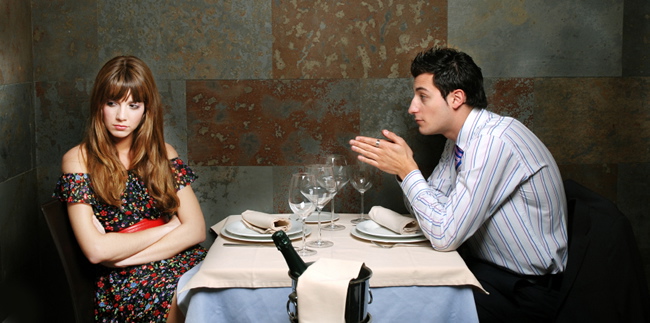
Bad Date

Almost exactly two years ago, I gave my mom and four siblings each a copy of War and Peace for Christmas. I’ve kind of been talking about it a lot lately.

The premise was to do a long-distance book group, at a nice and easy clip of 1200 pages in one year. That’s only 100 pages a month!  But I’ve since concluded that book group etiquette asks a commitment of at most 300 pages from each person at a time, preferably less. Although most of my family said they really wanted to read it, the execution itself was a little more… challenging. A year is a long time. 1200 pages is a lot of pages.

2009 came and went, but still I’d read only half. Then, in November of last year, with 800 pages under my belt, I decided enough was enough. And I finally finished, on Dec. 27, squeaking in just under the two-year mark.

And? It’s brilliant! Obsessed with the microcosm, Tolstoy deconstructs major historic events through the eyes of half a dozen characters whom we watch grow-up from childhood. He’s a starry-eyed romantic, yet he’s also one of the most weirdly hilarious guys I’ve ever read. Drunken frat boys wrestling bears, crabby old men with sneezing problems, Tsars throwing biscuits from balconies, anagrams of Satan’s name… When Tolstoy wants it to, the story really soars, and he’s the best drama queen that ever was a drama queen. Continue reading

The Other, Sadder, Face of the Library

So I know I like to have a little bit of fun here on Librarian in a Banana Suit.  In the last few months alone I’ve written about helping patrons find sex books, finding out if betrothed couples are second cousins or not, and scouring the catalog for novels about psychoactive soy sauce.

But there are many other facets to this job, too — many of them quite sobering.  Working closely with the public as trusted liaisons between them and their deepest information desires, we’re often asked very sensitive questions: we receive reference inquiries about domestic violence, unemployment, learning disabilities, and sexuality, and I’m astounded and humbled that patrons think of the public library as a place to find answers to these kinds of questions.  We can often refer them to social service agencies around the community, which I like to think means we’ve connected them with information that will ultimately really help them.

That’s not what happened a few weeks ago, though.  I was asked a different sort of question, one that was incredibly sensitive but indeed required the skills of a reference librarian.  Towards the end of the evening, a patron came in to look for the obituary of her friend.  She had been trying to get a hold of him on the phone for months when a mutual acquaintance told her that he’d committed suicide earlier this fall.  “I just want black and white confirmation, in print, that it’s true,” she told me.

Continue reading